Showing posts with label Judaism. Show all posts

Sunday, July 21, 2013

Attending B'Nai Mitzvah Stimulates Jewish Identity

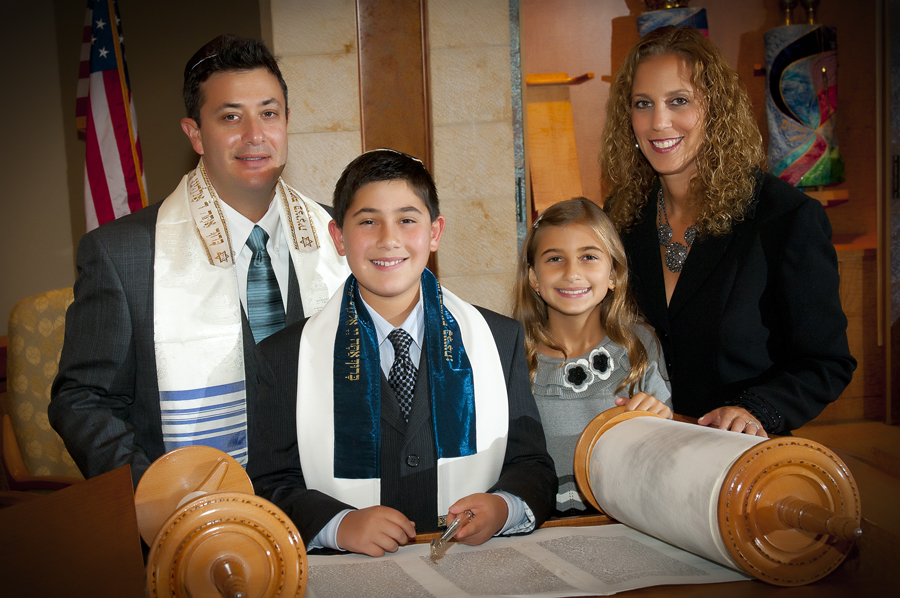
These are NOT the kids or the parents from yesterday.
Yesterday, I had the honor and pleasure to attend the Jewish coming-of-age ceremony of my friend John's two kids. His son, Sam, 13, and daughter Arielle, 12, stood before the congregation with their parents and helped perform the Shabbat ceremony, including reading from the Torah and later, explained the passages they read. The photo to the left is a stock one--not my friends--but shows what it looks like when the young "adults" read from the Torah for the first time.

After the ceremony yesterday came the wonderful food that is part of every Shabbat--and especially such an important one as this. It also lets the congregation and guests mingle--a very Jewish thing. My wife and I met another couple and spent time talking with them.

In the olden times, this special rite was the essential entry point into the serious business of  being a Jew. Of course, back then, girls didn't have one--they were very busy running the household with their mothers according to Jewish law and custom and weren't expected (or even allowed) to stand before the congregation this way. But this is 2013, and now, one of the touchstones of being Jewish is an equal opportunity affair. Having the two kids do it at the same time was a great idea, too.

Sam and Arielle are attractive, bright, and sweet young people, and it was a joy to watch them up there. They both claimed to be nervous, but it was not apparent to me. Sam's sense of humor and informality and Arielle's charm and sweetness made a good combination. You could see their parents beaming.

The ceremony, let by the typically affable yet learned rabbi (who was seated because of his broken ankle), managed to balance the dignity and significance of the occasion with the humor and warmth typical of Reform congregations. This felt like the the "temple" that I grew up in and he was like the rabbis I liked as a kid.

The music was simple, just a singer and a guitar, but moving and beautiful. We enjoyed several songs nicely rendered by the music director from the synagogue, and a couple of special guest appearances by Cantor Schwartz from Southern California. I enjoyed a conversation with the cantor after the ceremony that rekindled a little of the curiosity and interest that informed this Jewish blog last year.

Witnessing an event like this one can't help but stimulate a range of thoughts. For one, I remember my own Bar Mitzvah ceremony on a May morning many years ago. It was my great moment--the attention was on me--and I made the most of it. But I had just arrived in town the previous Fall, and my connection to the congregation and the rabbi was pretty fresh. Also, my family was going through a crisis that would culminate just a few months later with my parents separating. But all that was in the background on my special day. It was one of the moments when I actually felt connected to my tradition and that of my ancestors.

I appreciate that my parents put aside their troubles enough to make my special day, but the life I lived after their divorce was not very Jewish. In fact, the life before the separated wasn't either, but there is much to say about Judaism being a family and community religion, practiced at home as well as in the shul. The many activities, holidays, rituals, meals, and relationships are meant to create an environment conducive to thinking of and studying about Judaism. In that sense, studying the Torah in a room with others or alone--and preparing a Shabbat meal or lighting candles or preparing the home for a holiday, are all part of it. 

Although traditional, Orthodox Judaism has rigidly separated roles for men and women (which I am not interested in living today) the roles had equal value, or at least were supposed to. Part of why there is Reform Judaism (and Conservative and modern Orthodox) is because the world has changed and most Jews have changed with it. With so many options, a Jew today has to decide exactly what he/she will or won't do. It's not just about following the rulebook and showing up for everything. Some Judaism today incorporates yoga and meditation, which seems to go especially well when contemplating God.

Jewish events make me remember my father, especially during the Kaddish. This prayer, in ancient Aramaic, is one that I never said as a kid (pre-Bar Mitzvah) and by the time I needed it, when Dad passed away 11 years ago, I didn't know it or say it. My father didn't have a particularly happy connection to Jewish life, but still tried to give us at least something of it. On one side, the holidays felt sort of "tacked onto" our non-Jewish life in our non-Jewish suburban (and constantly changing) surroundings, but I still grew up knowing I was Jewish and not Christian or Muslim or Buddhist (or Athiest). I certainly wish that my parents had displayed more enthusiasm for the holidays and activities, but that was not the way we lived. We were assimilated and comfortable and that may be why I am open to all people and not Jewish-centered (and twice intermarried). It is what it is.

That doesn't mean that when I meet someone Jewish, I don't feel some sense of a common identity. I work with many Jews now, at my company, and feel that way about them. Most are from other countries, particularly Israel, but we have some bond that is greater than nationality and level of practice.The American Jews feel like the kids I knew in Sunday school.

When I see young people going through their Jewish rites of passage, like I saw yesterday, I sometimes have a little pang for the fact that I didn't and couldn't do this for my two fine sons. I am thrilled that they have grown to adulthood feeling like members of the human race, and are open and tolerant of others. But I have not passed on the history of my people to them. I have some regret, but also, accept that I don't live in a particularly Jewish way and can't expect them to. And, with non-Jewish mothers, only the Reform (and even more liberal flavors of Judaism) would accept them as Jewish anyway.

What now? I have revisited this Jewish Roots Project after more than a year because I felt like coming here. And it's the roots that remain, regardless of what has happened or will happen to the tree. What little shoots may grow from this is yet to be determined. But I also known that I can't leave this alone. It's up to me.

I'll be back.

Wednesday, June 13, 2012

Torah Study, Take Two

Torah study (not recently)
I tried Torah study several months ago at a Reform congregation in a neighboring community. That time, in the room crowded with people, all munching on bagels and chatting, I didn't feel that the content was covered in a way that enlightened me to the meaning in the text. It was mostly people expressing their opinions on the biblical content--not the knowledge or wisdom of the rabbi--or other scholars--leading us.

But last night was different. With Rabbi R R, my Chabad guide, along with me and two other men, sat in the quiet shul at a plastic card table and carefully went through a few sections of this week's Torah portion.

I learned a lot. We listened as the rabbi explained possible interpretations of the text--how different scholars would approach it. We learned there was a reference in a later part of the Torah that shed light on the portion and went there to read it.

We read some Hebrew--the language of the Torah. We had English to look at, too. We asked questions. We discussed what happened.

Did you know that the biblical Jews sent spies into Israel before attempting to enter the promised land? And that when the spies gave a report of a "land of milk and honey" -- but fierce people living there -- the leaders decided to stay in the desert? For that, they paid a price. They would stay in the desert for 40 years, and none of them would enter the land when the Jews finally went in!

How to interpret this? Here's one way to look at it. It was not necessarily that the leaders were afraid of the occupants of the land. That wasn't the issue. It was that in the desert all their needs were met, and they could study and be close to G-d all the time. However, they realized that entering the promised land promised to be a huge and difficult job. That's their big mistake.

How about that?

As these portions go, there are multiple topics. This one also mentioned the use of tzitzit (special fringes on the corners of four-cornered garments), which serve to remind Jews to observe the mitzvot. I enjoyed the fact that one of the three paragraphs I read every day when I put on the tefillin is right there--in the Torah!

I begin to see how a lifetime of this kind of study can slowly illuminate the story of the Jewish people. I'm looking forward to returning again for more.

Saturday, May 12, 2012

Howard Fast's The Jews--Story of a People

I just turned the last page of Howard Fast's The Jews - Story of a People. I was offered it by a friend in the orchestra and once I got going on it, it really riveted my attention.

The fat, 380-page, old-fashioned paperback, yellowing with age, reminded me of the delicate scrolls found by the dead sea in the 1940's--better turn carefully. The tale begins at the beginning--people very unlike today's Jews--and ends with modern life, including the State of Israel. Written in 1968, Israel had just won back some territory and the mood was exhilarating.

I learned a lot I didn't know about how Jews lived in different places and times. I didn't know about Jewish expertise in map making. It's pretty much assumed that a Jewish map expert was along with Columbus. Speaking of that, 1492 is associated with Columbus but is also the year that Jews were expelled from Spain. Because Jews were so actively involved in the economy of the country, it declined significantly after the expulsion. That showed them--well it probably didn't, since it appears that we don't learn much from history.

Jews were some of the great early doctors, and were way ahead of other groups in their knowledge and skills. That meant that many leaders kept a Jewish doctor on hand--even if the "official" policy was to drive them out of their country. Jews had well developed trade routes a thousand years ago which were broken up by the lunatic Crusaders.

The hardest thing in the book was to read about all the terrible things that have happened to the Jewish people--for so long and in so many places. So many killings and burnings and so much destruction. Some tyrant would go on a rant and hundreds of Jewish settlements perished. We all know about the Holocaust in Germany in the 1940's that took six MILLION Jewish lives--surely the worst thing ever to happen to one group of people. What I didn't know was the long history of German anti-Semitism. It was just the most recent outbreak of it. And what about the Crusades? Unspeakable horrors. It seems the Catholic church has had anti-Semitism as part of it's program since the beginning. I have hope that today is different, but we'll see.

Somehow, in his telling of the story of the Egyptian slaves to the desert wanderers, the first and second Temples in Jerusalem, and the varying strains of the Diaspora, Fast never gets you feeling too depressed. The greatness of how Jews have prospered--in spite of their difficulties--is very inspirational. And it ties in a little with what I'm sensing from my increased reading of the Jewish prayers. The tone is so positive and so much involved in praising God and feeling grateful to be alive that it must have sustained people through terrible times. Somewhere, in Jewish minds, there is a God who values the times we perform the commandments and the mitzvot we're asked to do. Well, of course, I don't do most of them, but I'm becoming aware of that as I learn what they are.

It's interesting to read about the early Jews--especially because there's so much we can't really know for sure. The later history, especially of the remarkable history of the Jewish migration from Eastern Europe starting in 1881 and lasting for decades, is easier to chronicle. I wish I could know more about my family--which came over in that movement. It's also interesting to read about the founding of Israel and the various ways that the countries tried to make it more difficult. Like anything, the more you know (and I'm just scratching the surface) the more complex the picture becomes.

I live in a special time and place on the West Coast of America in the 21st century, when it's fine to be a Jew and really no problem at all. The real issue, then, becomes assimilation, and I've done a perfect job of it. I can't be blamed, really, that in the freedom I've always known I've chosen not to participate in most of the Jewish things around me. The book places me more centrally in the history and future of Judaism. Strange that without the terrible situations that kept Jews together in their communities, we end up losing not our lives--or our comforts--but we do lose our connection to our culture and community.

What should my NEXT book be?

Friday, May 11, 2012

Upshernish - A Jewish Boy's First Haircut

Upshernish (this is not Yankele pictured)
Just one of the many traditions I didn't know about is the Upshernish (or Upsherin). It's a tradition for observant Jews to wait until the third birthday to cut a boy's hair. Of course, this means that some people will think the kid's a girl in the supermarket, but it has a real basis in what I'm increasingly understanding as a complex and meaningful world view of being Jewish.

Yesterday, I witnessed my first Upshernish, when Yankele, the son of my friend Rabbi RR and his wife, Fruma, had his long, curly locks trimmed. This is a very special young man. Besides being a beautiful-looking child, he has more self possession than many adults I've met. He is polite, respectful, well spoken and, from what I can tall, brilliant like his dad--and grandfather.

Yankele was named for his father's father, who was the esteemed Lubavitcher Rebbe's personal physician for two decades. Before the scissors came out, they ran a touching video showing Yankele at different ages, which included a tribute to his late grandfather.

Little Yankele sat on a special high chair and got his first snips from the Cohenim in the group. It's common in Jewish rites to have the descendants of the Jewish temple priests participate in a special way. I saw this at the Rabbi's new son's bris milah recently.

Afterwards, a fine spread of desserts was enjoyed by all.

This is not an event marked by prayer--it's one that marks a big change in a Jewish boy's life. Now, he begins to participate more fully in community life. Much like the the Jewish orchard commandment to not harvest the first three years' fruit, the fourth year is when the boy starts his Jewish education, working with what he has already learned. Little Yankele can say prayers already and surely knows a lot just from living with his family and community. Now, he will wear the peyot (sidelocks) and his kippa (cap) tzitit (fringed garment).  

It all made me feel the power of living a tradition. The Rabbi and his wife, extended family and entire community are celebrating this boy's increasing participation in his world, and are working to be sure that his education is carefully administered to make him into the person they want him to be. This kind of care and attention develops people who feel like part of something--and for whom their tradition is always meaningful and important.

We should all be so lucky.

This event is celebrated for any three-year-old boy--including the one in the photo above, who is not Yankele. It's a little like a junior-level bar mitzvah. If "Today I am a man" is the bar mitzvah theme, then "Today I'm not a baby anymore" would be the theme of the Upshernish.

The Rabbi told a joke (there's so much humor in Judaism!). There are the four cuts that a Jewish man endures. The first--circumcision, the second--the Unshernish. The third, at the bar mitzvah you cut him some slack, and the fourth--when he gets married and his wife cuts him down to size. I laughed.

Yesterday was also Lag B'Omer, so there was a bonfire and a delicious barbecue, but that wasn't directly related to the Upshernish, so I will talk about it separately when I go into the details of counting the Omer (which I've been doing "religiously." My joke.

Sunday, April 29, 2012

Bris Milah - Attending a Jewish Circumcision

Bris Milah (photo is not from today's ceremony)
Circumcision is common today, for male babies in more than just the Jewish community. It is the norm in the United States. However, for observant Jews, the Bris Milah is one of the most sacred rituals. It signifies the covenant between G-d and Abraham. Poor Abraham had to do it to himself--at age 99 no less, and to his sons, who were not infants.

On the male baby's eighth day, even if it's on Shabbat--the day of rest--he has his foreskin carefully but quickly removed by a trained mohel in a brief but essential ceremony for a new male member of the Jewish community.

It's right there in Genesis 17:10-12:
"Every male among you shall be circumcised... it shall be a sign of the covenant between Me and You. He that is eight days old among you shall be circumcised."

Why eight days? Today, we talk about the baby having enough vitamin K in his system for the blood to clot and other factors. But it's in the book. If the mohel happens to determine that the baby isn't ready, he can delay the circumcision.

Rabbi R.R., whose son received his welcome into the Jewish community today, told the congregation that this is not something a person decides with their reason. A baby is too young to know or decide. It's actually the father's duty to perform it--or designate an agent. The rabbi gladly turned the duties over to a trained pro today.

And why does a baby, just over a week old, have to suffer pain? Well, the rabbi explains, not everything is for our own pleasure--we owe something to the benefit of our community, and sometimes that means going out of our comfort zone. It's a paraphrase, but the point is, this is a male Jewish baby's first of many ways he is brought into the community.

It's also the day he receives his name. This beautiful young man is named after the great Rebbe Menachem Mendel Schneerson, a special honor. I was surprised to read that there are different ideas about naming in Judaism. In the Ashkenazic (Eastern European) community -- my ancestors -- you can name after an honored and beloved departed relative--but the Sephardic Jews also can name after a living relative.

Sitting there watching and listening, I heard prayers from those performing the ceremony and occasionally from the congregation. And, I heard some crying from the center of attention--at the cold air when his diaper was opened, at the brief cut from the highly trained and experienced ritual circumcisor, and that was it. The baby received a few drops of wine after the bris. He was already participating in the kiddush.

The community gathered around the baby as he was then carried gently through the crowd, receiving the love and blessing of his community. That reminded me of the joy and excitement attendees feel when the newly married bride and groom make their way out of their wedding ceremony.

Girls get a special naming too, at the synagogue when the Torah is read. 

Holding the baby before and during the ceremony is a great honor. During the circumcision itself the baby lay on his grandfather's lap. The people who bring the baby into the room are honored as well. Being in the room at all feels like something special, too.

It's Judaism, so that means a great feast afterwards. A sea of well-wishers crowded into the big room where the Passover seder took place just a couple of weeks ago and ate delicious meats, felafel and vegetables. Each round table had its own special cake, too.

As in the seder, there is a special chair set aside for the Prophet Elijah. When a king of Israel, under treacherous influences, abolished circumcision, Elijah protested to G-d, so he is now appointed to be present and witness all circumcisions.

Mazal tov to the parents, the baby and the community!

Note: Some information in this post comes from A Guide to a Bris - An Overview & The Service, which was supplied to everyone in attendance. I kept my copy and will place it in the Jewish Roots Project library.

Monday, April 9, 2012

Don't Pass Over Passover

I went to a Passover seder this year at the Chabad group I've been attending. It was certainly the largest one I've ever been to--with at least 100 folks in the Masonic Center (next to and across from the Christian churches). It was a nice experience, although I was surprised that it seemed to contain a good number of folks who are not Orthodox Chabad members. There were only a couple of black hats and long beards in sight.

That could be because there's a more intimate seder the day after at the Chabad house itself that may be the one the members gravitate to, but I know that as a non-member (but not a non-Jew) I felt like I fit in just fine.

When I walked in (early, of course), I met up with two couples (two brothers and their wives)--one with their handsome high-school-age son, and we got into a conversation. Apparently they've done seders here before, but the wives are not actually Jewish. The two brothers' father was not Jewish either, but mom was--and I met her--a sweet, friendly woman about my mother's age. The sisters and daughters arrived later.

We sat at the end of a banquet-room-length table--paired with another one on the other side of the room and a head table containing my friendly Rabbi RR and his brother, sister, and brother-in-law, among others.

A seder can go on for quite a while and you get pretty hungry before the meal arrives, so we were given a tasty salad to tide us over before the service actually began (at 8:09 p.m.--when three stars are visible in the sky). The we got down to the business of commemorating and reliving the Jews' historic exodus from Egypt thousands of years ago, led by the famous Moses.

I recognized the pieces of the seder plate (see photo) --the baked egg, lamb shank bone, parsley, horseradish, charoses, and so on--because I had seders as a kid, too. The ones I remember were in my family when I was maybe 10 to 15. The last one I had with my family was in 1968 when my father rejoined us just for the seder after my parents' divorce and we all sat around the dining room table and went through the story. I attended a seder in Israel in 1974 but I don't remember it very well--I had just arrived. I have had friendly ones in people's homes over the last few years, too.

There are thousands of different versions of the Haggadah (story of Passover in book form). Some are gender neutral, some are modern, some are quaintly old-fashioned. The book we used (in large and teeny versions) was charmingly illustrated and didn't seem to belabor any of the points. We got through the seder in 90 minutes or so. According to one of the Chabad members I knew from before--John--we may have had a  little "seder lite." He noticed that the rabbi didn't always read the entire passage, but skipped some. Perhaps the significant population of non-regulars prompted his decision.

Like so many aspects of Jewish ceremony, you're supposed to relive the experience, not just sit and talk about it. That's why during the week of Passover you eat matzo--unleavened bread--instead of regular bread. Traditionally, you clean the house thoroughly of any sign of risen dough before Passover. It sounds like a great reason to do a thorough spring cleaning --always a good idea.

The rabbi said we don't want to see this as some quaint observance of things long past, but as a living participation in the seminal event of Judaism. Yes, Abraham was born earlier, but the exodus into the holy land is what made Jews Jews.

Of course, Passover (or Pesach, as it's called in Hebrew) is ancient, and has not always been celebrated this way. According to Hayyin Schauss in The Jewish Festivals, it started out as a spring holiday that was combined with an unleavened bread holiday. It had its highest level of observance when the second temple stood in Jerusalem before it was destroyed by the Romans, when real animal sacrifices were done en masse and people gathered in groups to consume the special meat. Things broke down after the temple was destroyed, but Schauss says that Jews in the Middle Ages, who had  many issues to contend with, celebrated Passover much as we do today.


Saturday, March 31, 2012

Return to Kehilla for Singing

Last night I returned to Kehilla Synagogue, after my first visit of a couple of weeks ago. It was billed in advance as a musical service, and I was expecting a group of musicians and a big, noisy crowd. I got there and hurried to grab street parking, only to find a lot full of spaces in the lot. I once again expected hundreds but counted 19 folks (with a few stragglers). Most appeared to me middle-aged and older lesbian couples and there were three or four men besides me.

Inside the roomy sanctuary, we sat on folding chairs near the bima, with several candles set low before a Debbie and Julie, who are Kehilla songleaders. Julie I had met before, at the first service, when she showed me around the place.

The music ran from end to end, with nicely done drumming--Debbie is well regarded for her skill after decades of exploration. It gave a quality of Middle Eastern music, the rhythms keeping us all alert when there was also a tendency to feel sleepy. That's because there was a period early on where we got to schmooze a little. Later, we stretched, breathed deep and went on a guided meditation led by Debbie.

The service moved along, and I tried to sing along with it, referring to three different printed handouts. It was enjoyable in a way--but didn't feel especially Jewish to me. I'm used to the Reform service, which has music but is more of a "performance." I appreciated that we all were involved--and even that there was a period when we could speak about something we were dealing with--"crossing a bridge" as it were. But I got a little fidgety. Seeing a few attendees dancing freely alongside the group felt a little like something from a Grateful Dead concert.

Afterwards, we all met in the room downstairs and had a nice kiddush, sponsored by one of the women there. It felt warm and friendly. I was able to meet a few more of the congregants, and I sang along comfortably with the kiddush. Any time you can eat a handful of challah, pulled right off the loaf, it's a blessing.


The service was full of positive energy and included the essentials of Jewish ritual, but was also looser and had a sense of the experimental. Mention was made of the rabbi's recent meetings with other clergy to talk about the Occupy movement and while I found this interesting, I don't seem to be as focused on the political action component of Judaism as this congregation is.

I left with a strange feeling of disconnection. For some reason, this kind of service isn't moving me, and I'm not sure why. I get more invigorated by the more traditional Shabbat at the Chabad shul, even though I understand less of it. Despite my feeling of being part of the '60s hippie generation, I don't really relate to this kind of hand-crafted event. But that's part of  what my Jewish Roots Project is about--finding where I fit and where I don't.

I plan to come back again at some point to try another type of service to see how that works.


Sunday, March 18, 2012

Kehilla Synagogue--Intimate and Inclusive

I had the chance to spend Saturday morning Shabbat with the kind folks at Kehilla Synagogue. I had been meaning to go since it's not too far from home and I was eager to see what Renewal Judaism is like in an established congregation.

My previous experience with Renewal was with "chaverot," which meet in people's homes, gathering together for the high holidays (Rosh Hashana and Yom Kippur) but going their own way the rest of the time.

The Renewal movement of Judaism, which grew out of the 1960's and the Aquarian Minyan (founded in Berkeley in 1974). There is a strong sense of wanting to heal the world, partly from those who were appalled by the war in Vietnam and who had a stong sense of social justice. Kehilla is fully open to all, feminist, all-inclusive of gay, lesbian, bi, transgender--well--everybody--even non-Jews. And, as is the case in so many congregations today, couples often contain only one Jewish member. Kehilla has always been accepting of these families.

Kehilla (it means "community" in Hebrew) was founded in 1984 by Rabbi Burt Jacobson, who has been a rabbi for 45 years! He was there on Saturday and I had the pleasure to meet and talk with him a little.

I actually visited Kehilla many years ago when they shared a building with a church in Berkeley, but now, they occupy a fine old church at the edge of a thriving commercial street in Piedmont, California--right where it becomes a neighborhood of homes.

I wasn't sure how big a space it would be at Kehilla, but I was pleased to find that this Shabbat was intimate, taking place in Fireside Room downstairs. The main sanctuary looks big enough to handle a pretty large crowd, which it surely does on the major holidays. I got a tour from Julie, one of the first to arrive. She is involved in Kehilla's substantial music organization, a small part of which I enjoyed on Saturday. I also met Rina, who is a lifelong singer and who led the musical part of the service--which was a lot!

This service seemed like a good one to attend because it going to talk about art and creativity and how it relates to Judaism and spirituality. As a musician, I was intrigued. And we did talk about it, with Rabbi David Jonathan Cooper, one of the co-founders of Kehilla. He was serious, humorous, thoughtful, and very open. There were a few places in the service where congregants spoke about (or blessed) something--in this case, we spoke of light and of art.

I said a couple of things as part of the group. I have always had mixed feelings about this, because I feel like we non-rabbis are not experts, but the kind of inclusion at Kehilla felt right. There was a significant amount of praying, in Hebrew, but also singing--very pleasantly rendered with harmonies by several of the attendees.

My experience in childhood was of sitting and not participating, but Kehilla welcomes participation. When the Torah was opened up to be read, several of us took part, from unwrapping to holding, and when the three aliyas took place, anyone who wanted to could come up and do it together. I liked that. It spreads the honor. Nobody was dozing off or getting bored, although I was surprised at how many people joined the service after it had started.

I had thought that perhaps the Renewal service here would be too "way out" or not have a strong basis in tradition but I didn't find that here. I heard plenty of Hebrew, and some of the melodies were the same ones I learned in the Reform synagogue as a child. And, there were some new melodies, including ones written by people in that room.

After the service, which went for more than two hours (it felt like less), we went into the next room and celebrated with a nice oneg, with a spread of traditional Jewish food, including home-baked challah (thanks, Steve!) and we had a grape juice kiddush.

I had some interesting conversations. One person told me she and her husband joined because it was a community without gossip. Everyone got along. That seems like a good idea to me. Of course, I've had a pretty nice time at every service I've attended with the people themselves. When I consider affiliating with a congregation, perhaps next year, Kehilla will definitely be in the running. I felt at home there, and that whatever I was or did would be OK. My non-Jewish wife could come--if she felt like it--and nobody would mind. Kehilla is politically active and very much part of the modern world, which feels good--and different. The significant emphasis on music, participation and inclusion feels right.

It's a 20-minute drive away, too.

I plan to attend a larger event--a musical Shabbat at the end of the month, and will report back.


Tuesday, February 28, 2012

The Israel Birthright for Jews

Me in Israel a long time ago
The modern state of Israel has been a refuge for Jews around the world since it came into being officially in 1948. For many young people, it has also been a place to go to get a feeling for Judaism itself. Since 2000, Birthright Israel has led groups of young people ages 18 to 26 on ten-day trips of the Holy Land--at no cost! More than 300,000 young men and women have enjoyed the program so far.

It's a valuable experience to go to Israel. I went at 21--the target age for these travelers. I went through a different program, where you live on a kibbutz (communal farm) for a period of time and work. My program was an "ulpan," specially designed for immigrants, where you learn Hebrew in the classroom for half a day and work on the kibbutz the rest of the day. I didn't spend ten days--I was there for ten months! But, for the young folks taking one of these trips, it sounds fantastic.

URJ Kesher is the official trip organizer for Birthright Israel. Take a look at the itinerary and you can see that it hits all the high spots and gives a fine overview of the country for the visitor. You see not only visit the holy sites of Jerusalem but experience night life in the modern city of Tel Aviv, swim in the Sea of Galilee, float in the Dead Sea, sleep overnight in a Bedouin tent, climb historic Masada and visit the Yad VaShem Holocaust Memorial.

I'd love to go, because there's much that I missed in order to stay on the farm and make food for the animals and practice my Hebrew lessons. Every Jew should experience Jerusalem, and there is much about Israel that will be very different from home and exciting. I got to feel a little more what being an American was all about (If you're not from the U.S., what being from THAT place is like). Israel is unique. Check out a sample trip itinerary here.

In a time and place where it's easy to grow up knowing little of your Jewish heritage and not understanding the importance of Israel, ten days can make a big difference.

Sunday, February 19, 2012

Joining in at a Chabad Saturday Service

I was invited to attend a Saturday morning service by Rabbi RR, and I accepted. It was to be followed by lunch, so I figured I'd get a good chance to meet some of the people who attended the shul and see how they felt about things. Rabbi RR suggested I drop in once the service had already started, so I got there at about 10:30 a.m.

The Rabbi placed a tallit over my shoulders, directed me to come up to the front of the room, and I grabbed a siddur (prayerbook) and joined in.

While Reform and Conservative synagogues are set up on the "church" model, where the professional religious staff performs a ritual that parishioners may or not be involved in, the Orthodox model is more participatory. Although the rabbi is the nominal leader, anyone can direct the service who knows how it goes. There is an order, and there are some long prayers in Hebrew to say, but they're all there in the book. Occasionally, I watched the rabbi say a passage very quickly--like an auctioneer--and then slow down. Some of the people spoke the prayers at their own pace, and you could hear them in the background.

The centerpiece of a Saturday service is reading from the Torah--the sacred scrolls containing what a Christian would recognize as the first five books of the Old Testament or the Pentateuch. The common English translation is NOT the King James version, but it reads in a "thee and thou" way. There are other translations into more standard modern English too, but it's most satisfying to hear it in Hebrew, and then have the Rabbi explain what's going on.

It's an honor to help with the reading--to be called "up" for an aliyah. There is a short prayer that you chant before the section of the Torah portion that is read while you're up there, and a short concluding prayer. I was surprised--and pleased--to be called up for the fourth of the seven aliyahs. Using my Hebrew name--Shlomo ben Mendel--the rabbi beckoned me up to the folding table that he used to hold the precious Torah, which had been ceremonially removed from the "ark" where it normally lives. It had the wooden spindles on each end and the beautiful hand-written text on its parchment.

I said the first prayer--which I not only remembered, but got to hear three others recite before me, and it was written on a large card on the table in case you needed help to remember it. I was surprised that it was the very same one we used in the Reformed temple when I was a kid!

I stood next to the rabbi as he read, with my hand on the Torah's wooden handle. After reciting the concluding prayer a few minutes later, I moved to the side as a young man, came up and did his part. After you finish and step back to your seat, others shake your hand, congratulating you for participating. It felt great.

The service proceeded after the Torah reading for a while, including a Haftorah reading from the Prophets. At the end of the service, the rabbi wished us "Good Shabbat" and we stepped away to have lunch.

There was a nice spread in the kitchen, and I helped myself before sitting down at the long table with the others. We had a very pleasant and interesting conversation about Jewish subjects, including a little wine and some hard liquor (in small quantities). Shabbat is a happy time, even though we also discussed a few people who were ill and one man's sister, who had just died unexpectedly a few days before--in her 40's. The man had said the mourner's kaddish prayer during the service, so assumed that had suffered a loss recently.

The Orthodox service, as done by the Chabad folks, is inclusive, and I was pleased that I knew enough to participate. I felt at home there, which surprised me a little. I will be meeting with the rabbi this week to talk about the upcoming holiday of Purim, and I'm sure I'll be back for Saturday soon.

Friday, February 17, 2012

Judaism and Music - Keeping Two Streams Separate

Where's the bass player?
I have just returned from an abortive attempt to play the bass at a Friday night service. I had been concerned about this particular temple because of the minimal attendance but even more because of the erratic and unprepared nature of the cantor.

Tonight, I arrived on time and was ready to go, but she worked with two other musicians exclusively on a new song. I sat and listened for half an hour, doing nothing. Finally, we began on what was to be our second piece at the upcoming service. I played it through, and it sounded nice. She then decided that I should simply play the root of the chord for each measure, and proceeded to dictate these to me.

I decided then that this was not going to work for me. I packed my bass and came home.

I have believed for a while now that I could combine my love of music with my exploration of Judaism but that does not appear to be working for me. I have now played in a few different places and I am finding that I don't enjoy it. The parts are simple and repetitious--if there's one written at all--and are sometimes required with no rehearsal. There is lots of waiting around before and during the service. I am not having fun, and, with so much real music to play, I don't need this. So for now, I am separating music from my religions studies, until the time comes to reconsider under other circumstances. Maybe a Renewal congregation, filled with ecstatic worshippers, will change my mind.

Oddly, when I played the Faure Requiem in an Episcopal church last November, it was a wonderful experience. The piece itself took some hard work and the bass had a beautiful and worthwhile part to contribute. Of course, playing with several fine musicians, an 18-member choir and an organ was fine too. But that was church music!

It's hard enough for me to revisit Judaism in the first place. I remember attending services in a number of different temples as a kid and not really enjoying it that much. I got fidgety sitting on a hard, flat bench and repeating words written in a book that didn't mean anything to me. I didn't really need to watch a show. It seemed foreign and unfamiliar, and it felt like the other people knew each other--but I was alone.

My bar mitzvah training consisted of a few lonely months in a brand new place to which I had just moved the summer  before. Religious school on Sunday mornings when I was in the 9th and 10th grade seemed mostly irrelevant and a waste of a good weekend day.

I went to Israel in 1974 to get away from college for a while. Although it started out as a grand adventure, I spent nearly all my time on the kibbutz, which became a narrow routine, especially when my half days of Hebrew study ended after six months. I learned that I was very much an American, and although the Israelis and I shared a common heritage we did not share a common upbringing or attitude. 

So--what am I looking for now? Why am I devoting regular time and attention in 2012 to learning more about Judaism?

Well, there are some questions that aren't answered by music--or by what you do at your job. I want to understand more about life--and where I fit (and don't fit). I want to start asking the right kinds of questions. I think that the ancient tradition to which I am an heir is a fine place to start. And I have.

But I think I'll keep music, which is doing just fine, thank you, out of the picture.


Wednesday, February 8, 2012

Cut Down Too Soon

Today is Tu B'Shevat, the Jewish New Year for the trees. I celebrated it on Saturday, but today, the actual date of the holiday, it seems especially relevant, because on my street, a mighty redwood tree is being cut down. I assume that the tree removal company is not owned by a Jew because this has to be the worst time ever to do it.

I drove home yesterday and saw a terrible sight--a tapering trunk--poking up towards the sky--with no branches, and rudely severed at the top. A neat pile of firewood sat along the sidewalk, a sad remnant of the once mighty branches. I remember that you could stand under this tree when it was raining and be totally dry. No more.

I knew that this towering redwood was on its way out, and I had already said goodbye to it. Sadly, it had the bad fortune to be planted in a neighborhood of homes, sidewalks and sewer lines, and it was wreaking havoc on all of those. The current owner of the home by which it stands felt very bad about having to remove the poor tree, but it was damaging his home--and he wasn't the one who planted it. So it's not his fault.

The loss of this tree connected in my mind this morning with news from Facebook. Yesterday, I learned that my friend Lisa's brother had lost his only son, at the age of just 48. I don't know the details, but I do know that both the man and the tree were cut down too soon.

If we believe in a God who is loving and merciful, it's hard to accept some things in life. I don't believe that a higher presence is paying specific attention to each one of us--and making things good. The universe can feel pretty impersonal sometimes. The tree, of course, is easier to understand--it was a human decision to plant it and to pull it out of the earth. But why do people have to die before their time? Maybe it IS their time--and we just don't understand. But that doesn't really help.

I have a lot to learn.

Goodbye, redwood tree. Goodbye, Zachary.

Sunday, February 5, 2012

Tu B'Shevat with Shir Ami

Today, I took part in a Jewish holiday that I had never heard of or celebrated before. Tu B'Shevat, which occurs on the 15th of the Jewish Month of Shevat (Feb. 8 this year), is a marking of the new year for trees. Originally related to the tithing of produce grown in the Holy Land, it today is a time to celebrate by eating fruit specified in the Torah and think about the health of the planet we occupy.

I joined a friendly group of about 30 people at Congregation Shir Ami to commemorate the holiday. We gathered in the cozy room that serves as the central gathering place for the congregation and, similar to what we do on Passover, we read through a haggadah that walked us through four worlds as described in the Kabbalah: our actions, our emotions, our thoughts and spirits.

On each six-person table, besides red and white wine and flowers, was a large tray containing fruit from each world that would be available in Israel. As we progressed through the service, we ate a sample from each world, for example, almonds from world one, apricots for world two, and drank a cup of wine with it.

Interestingly, we mixed the red and white wine as we went, starting with all white, then white with a touch or red, red with a touch of white and finally, all red. Each time we ate, we said a blessing on the food (fruit of the tree) and each time we drank our wine mixtures, we sang the wine blessing.

As a relevant way of thinking about the earth on a day of trees, the haggadah contained information on ways to take care of the planet, from proper vehicle maintenance and using public transit to lower air pollution to not wasting water and recycling plastic containers. It concluded with The Ten Plagues of today:
  • Acid Rain
  • Melting of the polar ice caps
  • Diseased trees, destruction of the rain forests, forest fires
  • Pollution of oceans, lakes and rivers
  • Air pollution
  • Water shortages and droughts
  • Creating garbage landfills
  • Over consumption of energy
  • Extinction of species
  • Destruction of the ozone layer

No wonder Tu B'Shevat is called by some the "Jewish Earth Day."

An interesting note about trees: It was a custom in ancient Israel to plant a tree at the birth of a child. When the child grew up and married, branches were cut from the tree to hold up the chuppah (marriage canopy).

Three quarters through this very pleasant ceremony, we broke to enjoy a delicious lunch. The salads, soups and quiche, topped off by brownies, cake and coffee, were all excellent. Then, we went outside where the children were expertly guided in planting four slim new trees along the east side of the temple grounds.

Then we went inside to have our last cup of wine and conclude the service.

There is so much we can do about our planet, and a day like this reminds us about it. It also feels good to enjoy fellowship in the warm and friendly atmosphere of this community synagogue. I think I'll be back soon.

Friday, February 3, 2012

Sacred Space

I've been wrapping tefillin now for a little over a month, every day except shabbat. It's a quick process, but has extended little by little as I add a few words of the prayer I say. I now read two of the three paragraphs relating to putting on tefillin.

Today, as I entered the downstairs "office" I've been using, I saw a newspaper with a disturbing headline that I'd left there yesterday. I turned it over. Then, I saw someone's business card with a photo on it. I looked around and saw my mass of clutter--car models, papers, office supplies, junk. Too much distraction.

I realized that, for me, this room is starting to have some importance. It's my mini-shul now, and as that sacred space, it deserves better. So, it's time to clean it up. The table should be uncluttered, the hutch unburdened, the shelves, neat. Because whatever may be happening when I tie those leather straps onto my arm and head, it is putting me in a different frame of mind. That may very well be the entire purpose of doing it. I'll keep on and see.

Monday, January 30, 2012

Welcome to Torah Study


Yesterday, I went to my first Torah study group. I came away with mixed feelings.
It started out with a nice personal tour of the facilities, including the beautiful 100-year-old sanctuary and the brand new, starkly and unapologetically modern chapel, connected by the social hall named after a long-serving former rabbi. 
I joined the group in a classroom at the end of a hall. I arrived in time to find a good seat along the long table. The meeting ended up standing-room-only--probably 35 people. We had bagels with schmear and coffee, courtesy of one of the class members; a list circulated for others to volunteer this service for upcoming weeks. 
The class, I found out later, has been meeting for many years, and there were some obvious "regulars."
So, what was it like? The text for the day was the very beginning of the book of Job, from the Writings. I'd been looking forward to a stimulating, fast-moving study, but I felt there was too much nattering about trivial details before starting the actual examination of Job. I was annoyed by the know-it-all tone of a few of the class members. It reminded me of my mid-college years of sitting in a philosophy class waiting for things to move on. I didn’t have much to add on this first visit, but it seemed that we could have progressed more quickly and focused more on the meaning of the text. After about an hour and a quarter the group broke up--until next time.
There were a lot of elderly people there, and I made me uncomfortable. It felt like a diversion at the Jewish retirement home. As a member of a rock group and what I consider to be a "youthful" 58, it just felt too slow-moving. One ancient woman at the other end of the table stood up (very slowly) to announce her upcoming hip replacement surgery. Sigh. A distinguished-looking older African American man near me, wearing a middle-eastern style kippah, started going on and on about something he deemed relevant from another place in the Torah and the rabbi had to gently refocus the group.
It's quite possible that those who are interested in Torah study tend to be older folks who aren't sitting glued to their Facebook or other electronic social activities. It was only my first time there, and I brought in my own prejudices and habits. I felt that the "students" were blabbing on about their interpretations, but that may very well be what the class is about--to get different views and opinions on the material to somehow illuminate the text for everyone. Perhaps that's the ideal, but when I was a student, I wanted to hear what the teacher had to say, and I found this kind of woolgathering an inpediment. But it may be that I tend toward passivity and acceptance of the words of "experts," when one of the goals of Torah study is to actively question the material. But is fussing over the details beneficial or just intellectual fooling around?
Perhaps a smaller, younger group might work better for me. I'm not sure if I should perhaps visit this group again and try to come back with a different attitude. At the speed it was moving, though, it could take a decade to get through the Torah one time. But maybe there's no hurry.

Thursday, December 29, 2011

I Lay Tefillin for the First Time Today

Thanks to Rabbi RR, I got my first lesson on wearing tefillin today. This longtime ritual means actually following the instructions in the Shema prayer to wear the words as a "reminder between your eyes" and as a "sign upon your hand." So, you essentially tie a box with the prayer in it onto your bicep and on the top of your forehead above the hairline (if you have one) using leather straps.

You must tie them in a certain way and get the symbols correct. The numbers 3 and 7 are important. Also meaningful is that this ritual uses the head, the heart (the one on the bicep points to it) and the hand. This means that thought, feeling and action are all combined--that's a powerful trio.

The head must rule. The Rabbi told me how the word for king (melech) and fool (lemech) use the same letters, M, L and CH. So, using the first letters of the Hebrew names for head, heart and liver (action), which correspond to these three letters, it's a matter of having the parts PARTS IN THE RIGHT ORDER that defines the difference between a king and a fool. It probably works better with the real Hebrew. 8-)

Once you've got everything set up properly, the procedure is to say the Shema (Daily declaration of faith) prayer and then carefully put everything back in it's containers and bags for tomorrow. You take off the tefillin in reverse order that you put it on, so it's hand, head, arm.

Laying tefillin is a very literal activity, but as someone who grew up Reformed--and had lots of gaps in his education--this is a nice first step to experiencing something of what my more orthodox ancestors did. I'm especially honored to use Rabbi RR's fathers tefillin.

Updates as they happen.

Saturday, December 24, 2011

Exploring Jewish Roots - 2012

With the Jewish Roots Project, I will spend 2012 pursuing a wide and comprehensive view of Jewish life and how it affects me. This subject has come up periodically throughout my life, and I want to devote focus and energy to finding out not only what Judaism is and has been, but how I want to relate to my inherited culture for the rest of my life.

This will involve many processes.
  1. Interviewing rabbis, Jewish writers and artists, and anyone else who may have a perspective from which I can learn something.
  2. Reading a wide range of materials from novels to histories to religious books as well as periodicals, websites, and whatever else seems relevant.
  3. Practicing at least some aspects of the religion, including attending various synagogues, celebrating holidays, exploring Kosher food and wrapping tefillin.
  4. Blogging about the experience, while keeping my research findings and project diary private.
  5. Growing a nice Jewish beard (my usual length is number 2 on the clipper, but that will be changing).
  6. Adding to and changing the project over time as I learn more and get more ideas, but always aiming for daily involvement in some way.
  7. Making an assessment on January 1, 2013 as to the next step(s).

Thank you for joining me in this process. Please comment if you have anything you think I should investigate. Shalom and toda raba (thank you).