Showing posts with label Jewish ceremonies. Show all posts

Sunday, July 21, 2013

Attending B'Nai Mitzvah Stimulates Jewish Identity

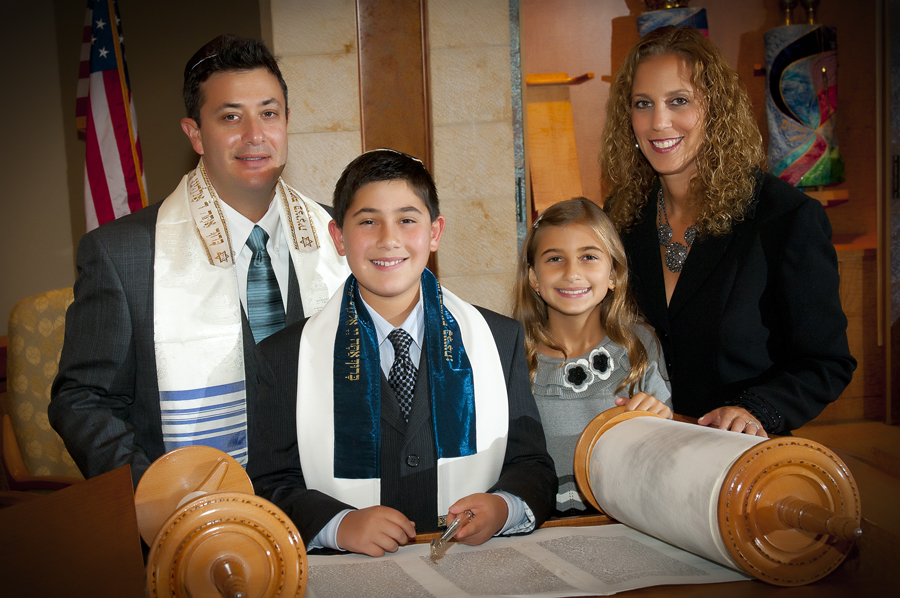
These are NOT the kids or the parents from yesterday.
Yesterday, I had the honor and pleasure to attend the Jewish coming-of-age ceremony of my friend John's two kids. His son, Sam, 13, and daughter Arielle, 12, stood before the congregation with their parents and helped perform the Shabbat ceremony, including reading from the Torah and later, explained the passages they read. The photo to the left is a stock one--not my friends--but shows what it looks like when the young "adults" read from the Torah for the first time.

After the ceremony yesterday came the wonderful food that is part of every Shabbat--and especially such an important one as this. It also lets the congregation and guests mingle--a very Jewish thing. My wife and I met another couple and spent time talking with them.

In the olden times, this special rite was the essential entry point into the serious business of  being a Jew. Of course, back then, girls didn't have one--they were very busy running the household with their mothers according to Jewish law and custom and weren't expected (or even allowed) to stand before the congregation this way. But this is 2013, and now, one of the touchstones of being Jewish is an equal opportunity affair. Having the two kids do it at the same time was a great idea, too.

Sam and Arielle are attractive, bright, and sweet young people, and it was a joy to watch them up there. They both claimed to be nervous, but it was not apparent to me. Sam's sense of humor and informality and Arielle's charm and sweetness made a good combination. You could see their parents beaming.

The ceremony, let by the typically affable yet learned rabbi (who was seated because of his broken ankle), managed to balance the dignity and significance of the occasion with the humor and warmth typical of Reform congregations. This felt like the the "temple" that I grew up in and he was like the rabbis I liked as a kid.

The music was simple, just a singer and a guitar, but moving and beautiful. We enjoyed several songs nicely rendered by the music director from the synagogue, and a couple of special guest appearances by Cantor Schwartz from Southern California. I enjoyed a conversation with the cantor after the ceremony that rekindled a little of the curiosity and interest that informed this Jewish blog last year.

Witnessing an event like this one can't help but stimulate a range of thoughts. For one, I remember my own Bar Mitzvah ceremony on a May morning many years ago. It was my great moment--the attention was on me--and I made the most of it. But I had just arrived in town the previous Fall, and my connection to the congregation and the rabbi was pretty fresh. Also, my family was going through a crisis that would culminate just a few months later with my parents separating. But all that was in the background on my special day. It was one of the moments when I actually felt connected to my tradition and that of my ancestors.

I appreciate that my parents put aside their troubles enough to make my special day, but the life I lived after their divorce was not very Jewish. In fact, the life before the separated wasn't either, but there is much to say about Judaism being a family and community religion, practiced at home as well as in the shul. The many activities, holidays, rituals, meals, and relationships are meant to create an environment conducive to thinking of and studying about Judaism. In that sense, studying the Torah in a room with others or alone--and preparing a Shabbat meal or lighting candles or preparing the home for a holiday, are all part of it. 

Although traditional, Orthodox Judaism has rigidly separated roles for men and women (which I am not interested in living today) the roles had equal value, or at least were supposed to. Part of why there is Reform Judaism (and Conservative and modern Orthodox) is because the world has changed and most Jews have changed with it. With so many options, a Jew today has to decide exactly what he/she will or won't do. It's not just about following the rulebook and showing up for everything. Some Judaism today incorporates yoga and meditation, which seems to go especially well when contemplating God.

Jewish events make me remember my father, especially during the Kaddish. This prayer, in ancient Aramaic, is one that I never said as a kid (pre-Bar Mitzvah) and by the time I needed it, when Dad passed away 11 years ago, I didn't know it or say it. My father didn't have a particularly happy connection to Jewish life, but still tried to give us at least something of it. On one side, the holidays felt sort of "tacked onto" our non-Jewish life in our non-Jewish suburban (and constantly changing) surroundings, but I still grew up knowing I was Jewish and not Christian or Muslim or Buddhist (or Athiest). I certainly wish that my parents had displayed more enthusiasm for the holidays and activities, but that was not the way we lived. We were assimilated and comfortable and that may be why I am open to all people and not Jewish-centered (and twice intermarried). It is what it is.

That doesn't mean that when I meet someone Jewish, I don't feel some sense of a common identity. I work with many Jews now, at my company, and feel that way about them. Most are from other countries, particularly Israel, but we have some bond that is greater than nationality and level of practice.The American Jews feel like the kids I knew in Sunday school.

When I see young people going through their Jewish rites of passage, like I saw yesterday, I sometimes have a little pang for the fact that I didn't and couldn't do this for my two fine sons. I am thrilled that they have grown to adulthood feeling like members of the human race, and are open and tolerant of others. But I have not passed on the history of my people to them. I have some regret, but also, accept that I don't live in a particularly Jewish way and can't expect them to. And, with non-Jewish mothers, only the Reform (and even more liberal flavors of Judaism) would accept them as Jewish anyway.

What now? I have revisited this Jewish Roots Project after more than a year because I felt like coming here. And it's the roots that remain, regardless of what has happened or will happen to the tree. What little shoots may grow from this is yet to be determined. But I also known that I can't leave this alone. It's up to me.

I'll be back.

Friday, May 11, 2012

Upshernish - A Jewish Boy's First Haircut

Upshernish (this is not Yankele pictured)
Just one of the many traditions I didn't know about is the Upshernish (or Upsherin). It's a tradition for observant Jews to wait until the third birthday to cut a boy's hair. Of course, this means that some people will think the kid's a girl in the supermarket, but it has a real basis in what I'm increasingly understanding as a complex and meaningful world view of being Jewish.

Yesterday, I witnessed my first Upshernish, when Yankele, the son of my friend Rabbi RR and his wife, Fruma, had his long, curly locks trimmed. This is a very special young man. Besides being a beautiful-looking child, he has more self possession than many adults I've met. He is polite, respectful, well spoken and, from what I can tall, brilliant like his dad--and grandfather.

Yankele was named for his father's father, who was the esteemed Lubavitcher Rebbe's personal physician for two decades. Before the scissors came out, they ran a touching video showing Yankele at different ages, which included a tribute to his late grandfather.

Little Yankele sat on a special high chair and got his first snips from the Cohenim in the group. It's common in Jewish rites to have the descendants of the Jewish temple priests participate in a special way. I saw this at the Rabbi's new son's bris milah recently.

Afterwards, a fine spread of desserts was enjoyed by all.

This is not an event marked by prayer--it's one that marks a big change in a Jewish boy's life. Now, he begins to participate more fully in community life. Much like the the Jewish orchard commandment to not harvest the first three years' fruit, the fourth year is when the boy starts his Jewish education, working with what he has already learned. Little Yankele can say prayers already and surely knows a lot just from living with his family and community. Now, he will wear the peyot (sidelocks) and his kippa (cap) tzitit (fringed garment).  

It all made me feel the power of living a tradition. The Rabbi and his wife, extended family and entire community are celebrating this boy's increasing participation in his world, and are working to be sure that his education is carefully administered to make him into the person they want him to be. This kind of care and attention develops people who feel like part of something--and for whom their tradition is always meaningful and important.

We should all be so lucky.

This event is celebrated for any three-year-old boy--including the one in the photo above, who is not Yankele. It's a little like a junior-level bar mitzvah. If "Today I am a man" is the bar mitzvah theme, then "Today I'm not a baby anymore" would be the theme of the Upshernish.

The Rabbi told a joke (there's so much humor in Judaism!). There are the four cuts that a Jewish man endures. The first--circumcision, the second--the Unshernish. The third, at the bar mitzvah you cut him some slack, and the fourth--when he gets married and his wife cuts him down to size. I laughed.

Yesterday was also Lag B'Omer, so there was a bonfire and a delicious barbecue, but that wasn't directly related to the Upshernish, so I will talk about it separately when I go into the details of counting the Omer (which I've been doing "religiously." My joke.

Sunday, April 29, 2012

Bris Milah - Attending a Jewish Circumcision

Bris Milah (photo is not from today's ceremony)
Circumcision is common today, for male babies in more than just the Jewish community. It is the norm in the United States. However, for observant Jews, the Bris Milah is one of the most sacred rituals. It signifies the covenant between G-d and Abraham. Poor Abraham had to do it to himself--at age 99 no less, and to his sons, who were not infants.

On the male baby's eighth day, even if it's on Shabbat--the day of rest--he has his foreskin carefully but quickly removed by a trained mohel in a brief but essential ceremony for a new male member of the Jewish community.

It's right there in Genesis 17:10-12:
"Every male among you shall be circumcised... it shall be a sign of the covenant between Me and You. He that is eight days old among you shall be circumcised."

Why eight days? Today, we talk about the baby having enough vitamin K in his system for the blood to clot and other factors. But it's in the book. If the mohel happens to determine that the baby isn't ready, he can delay the circumcision.

Rabbi R.R., whose son received his welcome into the Jewish community today, told the congregation that this is not something a person decides with their reason. A baby is too young to know or decide. It's actually the father's duty to perform it--or designate an agent. The rabbi gladly turned the duties over to a trained pro today.

And why does a baby, just over a week old, have to suffer pain? Well, the rabbi explains, not everything is for our own pleasure--we owe something to the benefit of our community, and sometimes that means going out of our comfort zone. It's a paraphrase, but the point is, this is a male Jewish baby's first of many ways he is brought into the community.

It's also the day he receives his name. This beautiful young man is named after the great Rebbe Menachem Mendel Schneerson, a special honor. I was surprised to read that there are different ideas about naming in Judaism. In the Ashkenazic (Eastern European) community -- my ancestors -- you can name after an honored and beloved departed relative--but the Sephardic Jews also can name after a living relative.

Sitting there watching and listening, I heard prayers from those performing the ceremony and occasionally from the congregation. And, I heard some crying from the center of attention--at the cold air when his diaper was opened, at the brief cut from the highly trained and experienced ritual circumcisor, and that was it. The baby received a few drops of wine after the bris. He was already participating in the kiddush.

The community gathered around the baby as he was then carried gently through the crowd, receiving the love and blessing of his community. That reminded me of the joy and excitement attendees feel when the newly married bride and groom make their way out of their wedding ceremony.

Girls get a special naming too, at the synagogue when the Torah is read. 

Holding the baby before and during the ceremony is a great honor. During the circumcision itself the baby lay on his grandfather's lap. The people who bring the baby into the room are honored as well. Being in the room at all feels like something special, too.

It's Judaism, so that means a great feast afterwards. A sea of well-wishers crowded into the big room where the Passover seder took place just a couple of weeks ago and ate delicious meats, felafel and vegetables. Each round table had its own special cake, too.

As in the seder, there is a special chair set aside for the Prophet Elijah. When a king of Israel, under treacherous influences, abolished circumcision, Elijah protested to G-d, so he is now appointed to be present and witness all circumcisions.

Mazal tov to the parents, the baby and the community!

Note: Some information in this post comes from A Guide to a Bris - An Overview & The Service, which was supplied to everyone in attendance. I kept my copy and will place it in the Jewish Roots Project library.